Lesson 9
Vacancies
Minimizing
Vacancies are one of the largest expenses in the
operation of income property. A one-month vacancy after each 12 months of
occupancy is equivalent to a reduction in rent or increase in expenses of about
8 percent. In addition, there are all the other costs of a vacancy,
including maintenance, utilities, and advertising. The total cost of an annual vacancy
is likely to be from 10 percent on up. The cash cost of extensive
rehabilitation and/or long-term vacancy due to the required work and/or a slow
market can easily result in huge negative cash flows.
On top of the actual
loss of rents and out-of-pocket cash expenditures, the landlord might also have
to invest significant amounts of time in order to replace a tenant.
Finally, there is the risk that the replacement tenant will be worse than the
old one.
In view of the cost of vacancy, it behooves a
landlord to avoid them and, when one can't be avoided, to minimize the length.
There are a number of factors that unnecessarily
create vacancies including the following:
- Inadequate screening
- Large rent increases
- Inadequate maintenance
- Bad landlord-tenant relations.
Inadequate Screening
Selecting a good tenant in the first place is the
most important thing that can be done to minimize vacancy. Maintaining
high qualifications standards, relative to the type and location of the
property, will make it more likely that the tenant can and will not only stay
the entire term of the lease, but it is more likely that they will want to
renew. Tenant screening and selection is covered in detail in Lesson
10.
Large Rent Increases
Considering the high cost of
vacancies, it certainly behooves a landlord to avoid creating a vacancy by
trying to pull an extra couple of percent rent increase out of a satisfactory
tenant. Setting rents is covered in detail in Lesson 9.
Inadequate Maintenance
Tenants who are content usually don't move unless
required by external circumstances. One of the ways to keep tenants is to
be diligent in responding to repair requests. And, you should start off by
making sure that the unit is in good condition in the beginning. Not only
will well maintained units attract better tenants in the first place and keep
good tenants longer, but it will keep you out of trouble with rental inspectors
and avoid disputes about rent withholding. Bad maintenance procedures can
also result in additional tenant damage. If you don't repair leaking
plumbing, leaking roofs and the resulting interior damage, keep the
landscaping looking good (if landlord's responsibility), is it surprising that
the tenant doesn't take any pride in keeping his unit clean and undamaged.
Maintenance issues are covered from the legal point of view in Lesson
6 and how to get the work done is cover in Lesson
3.
Bad Landlord-Tenant Relations
Tenant's often move, sometimes
breaking their leases, due to such things as privacy
issues, inadequate maintenance, and just plain nastiness of landlords.
Maintaining good relations in a businesslike manner is simply a good business
principle. We covered this subject in Lesson 8.
Anticipating
Knowing in advance when a vacancy will occur
is one way to reduce the impact, as it allows planning and scheduling. For a
month-to-month lease, the law of most states requires that the tenant provide at
least 30 days notice. However, the laws of most states do not require a
tenant to give notice if he is leaving at the end of a fixed lease. Accordingly,
landlords should keep track of lease expiration dates. Although not
enforceable in some states, it is also a good idea to have a lease clause that
requires 30 days written notice by the tenant whether he plans to leave at the
end of the lease or wishes to discuss an extension or renewal. If nothing
else, this provides written proof of intent in case the tenant hangs on after
expiration and invalidates any claims regarding oral agreement for remaining on
a month-to-month basis. If the landlord wants to retain the tenant, he
will normally want to send a notice stating the renewal terms well in advance of
30 days, with a request that the tenant return written notice of intent.
The properly written notice for signature and return should be provided by the
landlord. If the landlord prefers that the tenant not remain, a written
notice should be provided that reminds the tenant of the coming termination.
A reason for failure to allow renewal or extension need not and should not be
given.
Although the laws of most states allow showing of
units prior to being vacant, the lease should have a clause that specifically
covers the issue, providing for showings on 24-hour notice by any means (e.g.,
phone, e-mail, posted note) whether or not the tenant can be present.
Targeting Tenants
Think about your
building and who would make an ideal tenant for the unit that you have
available. Paint, decorate, and advertise accordingly. Match the
environment and condition of your property to who you would like as a tenant.
For example, if an older tenant would be better for a particular property, make
sure your unit is barrier free and decorated in a friendly traditional manner.
Target your marketing and media to places most likely to be seen by the people
who will best like the vacant property.
Pets
A review of typical vacancy advertising
in a local newspaper would lead you to believe that pets are poison in rental
housing. The ads will almost always culminate with: "No Pets allowed."
Many property managers have discovered, however, that a more prudent pet policy
can be profitable. Older adults often make the very best tenants. They can
usually afford the rent, are more responsible, have stability in their lives,
and ... often have a pet. In fact, more than one third of rental housing
residents have pets, whether the landlord approves or not.
Most pet owner tenants are actually willing to
pay pet deposits, or even higher rent to keep it. Good managers find ways to
attract and keep good tenants. Often their pet policy gives them a big advantage
over a less liberal c ompetitor.
If you are a no pet person, it may be worth your while to check our pets
pages. If you are an enlightened landlord who has discovered the value of
allowing pets, cash in on it by marketing your pet policy. ompetitor.
If you are a no pet person, it may be worth your while to check our pets
pages. If you are an enlightened landlord who has discovered the value of
allowing pets, cash in on it by marketing your pet policy.
Target your ads to pet owners by describing what
pets you are willing to accept. If you allow cats and dogs, particularly large
dogs, say so. Your pet policy itself will draw a large group of mostly
responsible older tenants that are not welcome elsewhere. Use a picture in your
advertising like the one on the left. Perhaps with a caption that you accept
people too.
There is a great deal of information on the value
to landlords of accepting pets on our RHOL
Pet Pages.
Advertising
Advertising is often the only way
to attract qualified prospective tenants to a property. The methods property
managers traditionally use vary from a simple sign in the window, to slick
brochures, ads, and mailers. What works best often depends on the
competitiveness of the market and even on the time of year. Many new landlords
are surprised to learn that, on average, 54% of tenants respond to signs on the
property and only 20% to expensive classified newspaper advertising. Today,
however, more and more mobile young people use the Internet to search for new
jobs and housing in the next town before they ever leave their current ones.
What ever advertising
medium is used, property owners must always be aware that housing discrimination
laws apply to all forms of advertising relating to housing offered for sale or
rent. Fair Housing Laws make it illegal to print or publish any real
estate advertisement that indicates a preference, limitation, or discrimination
based on race, color, religion, national origin, sex, handicap, or familial
status.
HUD has even selected 67 words that they believe
should be prohibited in advertising for housing. They are listed on our Fair
Housing Advertising Page.
Vacancy Listing on the Web
The newest, and perhaps soon
the best way to advertise rental housing vacancies is to post them on a
searchable vacancy listing site like our VacancyList.Net.
The Internet allows, landlords, tenants, buyers and sellers, to post their
information directly into a searchable database that can be accessed by others
from anywhere in the world. They can search for your listing by using keywords
like: country, state, city, metro area, price, housing type, description, and a
large number of other variables. VacancyList.Net.
The Internet allows, landlords, tenants, buyers and sellers, to post their
information directly into a searchable database that can be accessed by others
from anywhere in the world. They can search for your listing by using keywords
like: country, state, city, metro area, price, housing type, description, and a
large number of other variables.
If you are a Landlord or Property Manager who
also owns and/or manages commercial property, you should visit our Haves
& Wants Web Site.
Print Advertising
Newspaper classified advertising is the
traditional medium used for rental housing. It should briefly describe and sell the primary benefits of the
property, but must not contain any discriminatory language. Classified
advertising should contain the following:
rental housing. It should briefly describe and sell the primary benefits of the
property, but must not contain any discriminatory language. Classified
advertising should contain the following:
- Description of the rental property. (2 BR home- duplex-apartment )
- Features and benefits of the property (garage, basement, fenced yard,
special discounts.)
- Price of the unit. (Stating the price will eliminate calls from those
who cannot afford the unit.)
- Address of building. (Including the address will limit your calls to
those who want to live there.)
- Phone number to call for more information.
- If you are a licensed real estate agent, many states require the name of
the licensee to appear in the ad.
There is a real estate axiom that
if they call on a for sale or rent sign, they probably can't afford the house;
if they call on the price in the ad, they won't like the house when they learn
the address and drive by it. Save yourself a lot of wasted time by always
listing both the price and the address in your advertising.
To avoid charges of discrimination, property
owners should adhere to the following advertising guidelines:
- Do not use words such as "desired" or "preferred."
Using that kind of language can indicate a discriminatory preference. For
example, "working females preferred" indicates discrimination
against ... say, male dead-beats. "Singles desired" obviously
indicates a discriminatory preference against families.
- Always avoid words that imply discrimination against families or children.
"Security deposit for children," "adult building," or
"retirement community" is generally discriminatory, unless the
property qualifies as housing for the elderly by conforming to one of the
few legal exceptions.
- Do not use ethnic and religious connotation. An ad that reads, for
example: "Village Manor Apartments are located near the Catholic
Church," indicates a preference for Catholics, and implies that
non-Catholics would be happier elsewhere. "Convenient to
Chinatown" may indicate a preference for Asian tenants.
- Don't use photographs of people. Using people in advertisements can
indicate a preference for the kind of person depicted. If a particular
protected group is not represented in the advertisement, discrimination may
be inferred.
- "Absolutely no pets" could indicate to a prospective tenant who
is blind that you will not even allow seeing eye dogs. Using the phrase
"no pet policy," is acceptable because it does not imply a strict
prohibition against all animals. Besides, responsible but lonely older
adults, who make great tenants, often fill their lives with caring for a
pet. No pet policies can therefore be expensive and short sighted.
- Avoid discrimination in the selection of places to advertise. It is
usually a good idea to place your advertisements in general circulation
print media, read by the public at large. Newspapers targeted to Hispanic,
Haitian, Korean, Polish, or any other group could lead to possible expensive
allegations of discrimination. However, if you own property near a hospital,
factory or college, there is nothing wrong with advertising in their
newsletters. In fact, it is often the best place to advertise.
- Use the Fair Housing Logo. It indicates that you know and obey the law.

- See our Fair
Housing Advertising Page.
Other Kinds of Advertising
- For Rent signs are usually effective and are the reason
most tenants apply for a
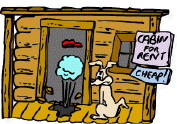 particular rental unit. Friends and family of your property's neighbors are
always your best prospects. For Rent signs should be clearly visible,
simple, attractive, and well-maintained, but they must not contain anything
discriminatory. The number of bedrooms, the words: "For Rent" and
a phone number to call is generally adequate.
particular rental unit. Friends and family of your property's neighbors are
always your best prospects. For Rent signs should be clearly visible,
simple, attractive, and well-maintained, but they must not contain anything
discriminatory. The number of bedrooms, the words: "For Rent" and
a phone number to call is generally adequate.
- Apartment guides or magazines are effective in some
areas, particularly for larger high end apartment complexes, but they are
not designed to fill just one current vacancy. Guides are usually published
monthly, printed on attractive glossy paper, in color, so advertising rates
tend to be relatively high.
- Apartment locator and vacancy listing services can be
effective in areas where such companies are well established, or in a
high-vacancy rental market. These services typically charge the owner a fee
for each successful referral. Fees can equal one-half to a full month's
rent.
- Direct mail of flyers and brochures to tenants in other
nearby properties can be an effective marketing tool. Although that may be
upsetting to your competition. You can also post the material in
supermarkets, stores, Laundromats and other places frequented by area
residents.
- Word-of-mouth advertising from existing tenants is often
the best advertisement. If state laws permit, many landlords pay a finder's
fee for each successful referral. Some states classify finder's fees as
commissions, however, which may be paid only to persons holding a real
estate license. Landlords who want to establish a referral payment program
may be able to contact their local real estate board to learn whether finder
fees are legal.
- Employers in the local rental market. Try to contact
human resource managers to get permission to place notices on company
bulletin boards or in workplace newsletters.
- Military. If your market area serves a nearby military base
or post, list your property with the facility's Housing Office. On the
plus side is the fact that you will likely have your rent on time and your
property will be well taken of. Failure to do either can cause serious
damage to the careers of military personnel. On the negative side is
the fact that you will likely have to include a Military
Clause in your lease, giving the tenant the right to terminate the lease
in event of non-voluntary deployment or transfer.
In a tight rental market many
successful property managers advertise an open house at the vacant property and
make a party out of it, rather than arrange for separate private showings. When
several prospects show up together, they will occasionally bid against each
other for the chance to rent an attractive unit and even pay more than the
advertised price to get it. It is a good system if you are careful to always
offer the property to the "first qualified tenant" who will pay the
price, not the "most qualified".


 |
|