|
Lesson 5
Health & Safety
Landlords are sued more than any other group
of business owners in America. The average settlement paid by a landlord's
insurance company is $600,000 and the average jury award is $1.2 million.
Aside from civil rights violations, most lawsuits are related to health and
safety issues.
While both commercial and residential income
properties have health and safety issues, we will focus primarily on issues of
concern for residential. Many issues are of greater concern or only of concern
for residential because those who utilize residential space do so for longer
periods of time. For example, radon is usually of no concern for commercial
property because radon presents little danger for exposure totaling a few
hours per week compared to 20 hours per day for years.
Health
Landlords are increasingly being held liable for
tenant health problems resulting from exposure to environmental poisons in the
rental premises. Potential problems include asbestos, lead, mold, pests, and
radon. You may want to check out our environmental
pages to help you become aware of potential problems and perhaps how to deal
with them.
Asbestos
Asbestos is a
problem because, as a toxic substance and a known
carcinogen, it can cause several serious diseases in humans.
Sym ptoms of these diseases typically develop over a period
of years following asbestos exposure. Asbestos-containing
materials (ACM) in buildings do not always
pose a problem (that is, a hazard) to occupants and workers
in those buildings. When can ACM become a problem? When
asbestos fibers get into the air and are inhaled; that is,
when there is human exposure. ptoms of these diseases typically develop over a period
of years following asbestos exposure. Asbestos-containing
materials (ACM) in buildings do not always
pose a problem (that is, a hazard) to occupants and workers
in those buildings. When can ACM become a problem? When
asbestos fibers get into the air and are inhaled; that is,
when there is human exposure.
Intact,
undisturbed asbestos-containing materials generally do
not pose a health risk. They may become hazardous and pose
increased risk when they are damaged, are disturbed in some
manner, or deteriorate over time and thus release asbestos
fibers into building air. EPA's asbestos
program for schools (AHERA) and its guidance for
other building owners is founded on the principle of "in-place"
management of ACM. This approach is designed to
keep asbestos fiber levels low by teaching
people to recognize asbestos-containing
materials and actively manage them.
Asbestos Ban
- EPA has found that there are rather common
misunderstandings about its 1989 bans on
asbestos-containing materials (ACM) and products or uses. Newspaper
and magazine articles, Internet information, even some currently
available (but outdated) documents from the EPA and other federal
agencies may contain statements about an EPA asbestos ban that are incorrect.
In fact, in
1991 the U.S. Fifth Circuit Court of Appeals vacated much of the so-called
"Asbestos Ban and Phaseout" rule and remanded it to the EPA. Thus,
much of the original 1989 EPA ban on the U.S.
manufacturing, importation, processing, or
distribution in commerce of many asbestos-containing product categories
was set aside and did not take effect. Six asbestos-containing product
categories are still subject to the 1989 asbestos ban. However, EPA
has no existing bans on most other asbestos-containing products or uses.
Lead
Scientists and government health agencies
recognized that there were health problems caused by lead poisoning many years
ago. Lead paint was banned for use in European housing more than sixty years
ago. The use of lead to raise the octane in gasoline and the manufacture and use
of lead-based paint in housing was finally prohibited in the U.S. in 1978.
Failure to make full disclosure and remedy
environmental hazards such as lead, is not only very risky business, but as of
September, 1996, disclosure of lead hazards is required by federal law.
Even if you didn't cause or know about lead-based paint or pipes in a rental
building, you have an obligation to give tenants notice that such hazards even
might exist.
The Residential Lead-Based Paint Hazard Reduction
Act, commonly known as Title X (Ten), was enacted in the U.S. 1992 and
Environmental Protection Agency (EPA) regulations implementing Title X as to
rental property were implemented in September and December of 1996.
Before signing a lease or rental agreement, a
landlord has been required to give every new tenant since 1997 the EPA pamphlet,
Protect Your Family From Lead In Your Home. Both the landlord and tenant
are also required to sign an EPA-approved disclosure form that will prove that
the landlord told the tenants about any known lead-based paint or hazards. The
required lead documents are available to members in the Forms
Web.
Property owners must keep the disclosure form as
part of their records for three years from the date of the start of the tenancy.
While EPA regulations do not specifically cover tenancies created prior to
September 1996, landlords should error on the side of caution and disclose
information on lead-based paint or hazards to all residential tenants.
These properties are not covered by Title X:
- Housing certified as lead-free by an accredited lead inspector
- Lofts, efficiencies and studio apartments
- Short-term vacation rentals
- A single room rented in a residential dwelling
- Retirement communities (housing designed for seniors, where one or more
tenants is at least 62 years old), unless children are regularly present.
In addition to the federal regulations, some states
also have there own lead paint laws, usually more stringent than the federal, so
investors in pre-1978 residential income property should be sure to understand
the lead paint laws of the state in which they invest. The RHOL web site
has considerable information regarding lead
paint issues.
Mold
The first case alleging mold
contamination was settled about 5 years ago for 11.4 million dollars. Since
then, significant developments have followed. Court cases have increased at a
rapid rate and insurance coverage has decreased. Owners and managers of income
property (landlords) should be aware that toxic mold lawsuits are being brought
by residents claiming both property damage and personal injury. The best
protection against potential liability is a broad program of prevention.
Mold growth is facilitated by excess moisture.
Accordingly, moisture control prevents indoor mold growth. Actions that can be
taken by landlords includes the following:
- Repair leaking plumbing and control sweating plumbing
- Improve ventilation in areas that have moisture sources (e.g., bathrooms
& laundry room)
- Make sure drain spouts direct water away from foundations
- Eliminate leakage around windows and doors
- Avoid cold spots on interior walls by proper placement of ducts
- Replace impermeable (e.g., vinyl) wall coverings with permeable
ones.
- Install ceiling fans and consider forced air heating where not already in
place, as they increase air movement which inhibits mold growth
Comprehensive information about detection and
correction of mold infestation can be found on the EPA
web site
and in the EPA publication "Building Air Quality, a Guide for Building
Owners and Facility Managers." You should also read the RHOL moisture
page. Two EPA web pages of interest are:
"A
Brief Guide to Mold, Moisture, and Your Home"
"Mold
Remediation in Schools and Commercial Buildings"
Landlords should also have a written plan
covering operation and maintenance as related to mold. The plan should
include documentation of any actions taken and it compliance with local laws and
with ASHRACE standards. Federal law regarding airborne mold contamination
expired at the end of 2000, but many states already have laws on the books or
are currently working on them. In the absence of governmental mandates,
Landlords who have a plan that reflects proper maintenance procedures that are
carried out by adequately trained persons will have shown good faith.
Safe and healthy indoor air quality should be
considered of paramount importance and complaints by tenants must be taken very
seriously. The lease should include specific instructions about who to
notify in the event of leaking plumbing, "off" smells, standing water,
or any other conditions that suggest a mold problem or might potentially
facilitate mold growth.
Pests
Pests can include cockroaches, ants,
crickets, mice, rats, flies, scorpions, snakes, and almost any other living
thing that a tenant might not want to see in his unit or yard. Some of
these items are health issues (even safety issues), some are not. Even
those which present no health or safety risk must be dealt with if the tenant is
concerned about them. Whether or not it is he landlord's responsibility to
deal with pests depends upon (1) the lease, (2) the type of property, (3) the
kind of pest, and (4) maybe a judge's whim.
As an item of interest, consider the following.
You would think that anyone renting or buying a home in the desert should be
expecting to share the the space with the natural residents there.
However, because of increasing incidences of lawsuits related to scorpions and
snakes, the Arizona Association of Realtors has found it necessary to recommend
disclosure of the obvious, that such creatures live there, in real estate sale
transactions. While such disclosure is not yet required by law in most
jurisdictions that have such creatures, a prudent landlord in an area where they
are particularly prevalent might want to consider providing it.
The lease can sometimes assign responsibility for
pest control to the tenant. Whether you can do so can depend upon the type
of property. For a single-family home, you can likely make the tenant
entirely responsible for future control so long as it clear when the tenant
moves in. For a multi-unit building things are more complicated. For
pests that move among units (e.g., crickets, cockroaches) the landlord should
probably take responsibility, even if the law doesn't require it, because
control must involve all units at the same time. For pests that are a
problem for one unit only, particularly when that unit is attracting the pests
through negligence or bad housekeeping (e.g., food left out that attracts ants
or fleas from their own dog) you may be able to put responsibility onto the
tenant, particularly if the lease specifically deals with the issue.
If the problem is in a gray area, you are
probably better off to take care of it as a good will gesture for better tenant
relations. It will certainly be a lot cheaper than a vacancy.
Radon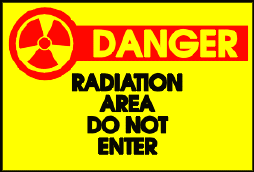
Radon is a radioactive gas which is
one of the decay products of the element radium.
Radon comes from the natural (radioactive) breakdown of uranium in
soil, rock and water and gets into the air you breathe. Radioactive decay
is a natural, spontaneous process in which an atom of one element decays or
breaks down to form another element by losing atomic particles (protons,
neutrons, or electrons).
You can't see radon. And you can't smell it or
taste it. Radon is estimated to cause many thousands of deaths each year.
That's because when you breathe air containing radon, you can get lung cancer.
In fact, the Surgeon General has warned that radon is the second leading cause
of lung cancer in the United States today. Only smoking causes more lung cancer
deaths. If you smoke and your home has high radon levels, your risk of
lung cancer is especially high. Cigarette smoking, the major cause of lung
cancer, is responsible for 85 percent of the 170,000 cases diagnosed each year.
Radon represents a far smaller risk for lung cancer and is estimated to be
responsible for roughly 10 percent, or 17,000 cases per year. This estimate may
be as low as 6,000 to as many as 36,000 radon-associated lung cancers per year.
Although the association between radon exposure and smoking is not well
understood, exposure to the combination of radon gas and cigarette smoke creates
a greater risk for lung cancer than either alone. The majority of radon-related
cancer deaths occur among smokers.
In a few areas, depending on local geology, radon
dissolves at high concentrations in ground water where it can then be released
into the air when water is used.
Out of doors, radon gas exists at harmless
levels. However, in areas without adequate ventilation, such as
underground mines, radon can accumulate to levels that substantially increase
the risk of lung cancer.
Radon can be found all over the U.S.
It can get into any type of building - homes, offices, and schools - and build
up to high levels. But you and your family are most likely to get your
greatest exposure at home. That's where you spend most of your time.
Radon is a problem primarily in certain areas and tends to be rather localized
even within those areas. Newer construction, which tends to be more
air-tight, and basements, which are surrounded by dirt, are usually more likely
to have higher radon concentrations. The level of Radon found in a
basement can be 1,000 times the level in the attic.
Testing is the only way to know if
there is a risk from radon in a particular property. Indoor radon levels
are affected by the soil composition under and around the house, and the ease
with which radon enters the house. Homes that are next door to each other
can have different indoor radon levels, making a neighbor's test result a poor
predictor of radon risk in your home. In addition, precipitation, barometric
pressure, and other influences can cause radon levels to vary from month to
month or day to day, which is why both short- and long-term tests are available.
Because radon levels can vary from day to day and month to month, a long-term
test is a better indicator of average radon level. EPA and the Surgeon General
recommend testing all homes below the third floor for radon. EPA also
recommends testing in schools.
Testing is inexpensive and easy - it should only
take a few minutes of your time. Millions of Americans have already tested their
homes for radon. There are simple ways to fix a radon problem that aren't
too costly. Even very high levels can be reduced to acceptable levels.
Short-term tests track radon levels for up to 7
days. Long-term detectors give the average concentration for periods of 90
days or more. Both tests are relatively easy to use and inexpensive ($10
to $30).
Once a radon problem is corrected, the hazard is
gone for good. Costs for reducing radon levels typically range from $500 to
$2,500, with an average cost of $1,200. A state or local radon official
can explain the differences between testing devices and recommend the most
appropriate test for your needs and conditions. The EPA has a list of
types of radon detectors meeting their standards.
Radon is not currently an issue of universal
concern. To our knowledge, no jurisdiction requires radon inspections or
disclosures by law. However, it is recommended that abatement be
undertaken if radon is known to be at higher levels than federal standards.
Safety and Security
Although safety and security can be somewhat
intertwined by the broadest definitions of both terms, we will consider safety
issues to be those related to accidental injury and security issues to be those
related to injury caused by others. Hence, a hole in the sidewalk that
might cause someone to fall is a safety issue, whereas, hiring a convicted
sex-offender as gardener is a security issue. Inadequate lighting can be
both a safety and a security issue. As with most things, you need to be
aware of any special requirements related to these issues in your state and
local area. For example California, has specific requirements for door
and window locks.
Locks
Locks are relatively cheap and easy to install or
add. They may even help save lives and property. Letting your
tenants and property be an easy mark for a criminal, or renting to one, invites
both traumatic and expensive trouble.
When a tenant departs, the landlord has way to
know how many keys are in existence nor who might have one. Accordingly,
the best policy is to re-key every lock each time there is a change in tenants.
The cost of re-keying is almost negligible if a landlord invests in moderately
priced re-keying kits. Owners of multiple properties can avoid the labor
involved in that approach by keeping a few extra locks on hand and rotating
locks among properties. Even the single-unit landlord can re-key his locks for
$5.00 per lock plus about $1.50 per new key if he takes them into a home
improvement store himself. A landlord's expenditure of $25 or less to
re-key a unit is an important investment in the safety of his new tenants and a
major reduction in exposure to costly lawsuits.
California
has, since July 1, 1998, had a law requiring landlords to install and maintain
working deadbolt locks on each entry door, window security devices or locks on
all windows designed to be opened and locking mechanisms on exterior doors to
common areas of the building. All locks and installations must comply with
local and state building, fire and safety codes.
Windows that can't be reached from the ground,
roof or other platform are exempt, as are louvered and casement windows. The
required distances for lack of access are 12 vertical feet and six horizontal
feet. Buildings officially designated as historically significant are exempt
from the law.
If a landlord fails to install and maintain
deadbolt and window locks, the tenant must notify the landlord and allow him
or her a reasonable time to make the necessary modifications. After that,
tenants can repair and deduct or take further legal action to enforce the
requirements.
Lighting
Exterior and common area interior lighting can be
of concern regarding both safety and security. Parking lots, carports,
sidewalks, stairways, porches, hallways should all be well lit. Operation
of lighting should be checked regularly and the check should be done at night.
For energy conservation, most lights controlled by timers or solar cells, with
the latter being preferable where possible because timers require regular
adjustments throughout the year. Also, timers do not take into account
cloudy days that can require lighting in some interior zones.
Guards
Employing guards can provide additional security
and safety for larger complexes where the budget so allows. However, it can also
actually create additional liability for the landlord in the following ways.
- Conflict between guards and tenants can sometimes be a problem. Low
pay for rent-a-cops often results in inadequately trained and supervised
guards - retired or off-duty law enforcement officers are usually better.
- Hiring guards implies that there were problems to begin with, perhaps
proving some liability for past events.
- The presence of guards may give false sense of security, making both the
tenants and management less vigilant.
- Future elimination of guard services may, in itself, be judged negligent,
particularly if done to save money rather than because the source of
original problems has been reduced or eliminated.
Fire extinguishers
Many state also have laws regarding
the availability of fire extinguisher. They usually must be available on
every floor of an apartment building or in every 75 feet of hallway. Some states
or local jurisdictions require them in each kitchen.
Smoke Detectors
Perhaps the most important safety devices a
property manager can install are smoke detectors. Most building codes now
require at least one ionization detector on each floor of a dwelling. Many
mandate a detector in each bedroom as well.
The most commonly used smoke detector uses
ionization detection, because it is the cheapest to manufacture. They are
allowed by most housing codes and work just great for fast developing fires.
However, they may not alert a sleeping child to a slow smoldering fire that can
fill a room with deadly smoke before it goes off.
 The alternate choice is a photo-electronic smoke detector. It will detect
smoldering fires, and could provide as much as fifteen minutes of
additional escape time. The photo-electronic unit is also sold in a
combination alarm, meaning it has both the ionization and the photo-electronic
detector in one package. The duel detector is substantially more expensive, but
by far a better choice over any single sensing detector.
The alternate choice is a photo-electronic smoke detector. It will detect
smoldering fires, and could provide as much as fifteen minutes of
additional escape time. The photo-electronic unit is also sold in a
combination alarm, meaning it has both the ionization and the photo-electronic
detector in one package. The duel detector is substantially more expensive, but
by far a better choice over any single sensing detector.
Smoke alarms do not detect flame, heat, or gas.
They can only detect smoke ... if it can get to them. That's why most local
codes now require that they be installed in each bedroom, adjoining hall ways to
the bedrooms, on each level of the house and in the garage and basement.
They usually must be installed in the common areas of apartment buildings and in
every bedroom of a rooming house.
Smoke alarms initially relied on 9-volt battery
power, the same size batteries that are used in many toys and other household
items. As a result, the batteries were often removed for other uses and the
detector became useless. Now many building and housing codes require smoke
detectors to be hard wired into a house circuit, with battery back-up. They can
be wired so that they are all connected together. That way, if one detector goes
off do to smoke, it will activate all the other alarms. The best protection
possible today.
Carbon Monoxide Detectors
Carbon Monoxide (CO), known as the "silent
killer" is a colorless, odorless gas generated by any fossil-fuel (oil,
gas, coal, wood) burning device, including furnaces, kitchen ranges, water
heaters, and clothes dryers. Since CO is a product of incomplete
combustion of the fuel, devices that are not well-maintained are particularly
dangerous. Inadequate venting for the device is another source of danger.
Since gasoline engines also generate CO, attached garages are also a potential
source of danger.
Although only a few jurisdictions to date require
CO detectors by law, the number doing so will almost certainly increase rapidly
in the future. Even when not required by law, landlords will be exposed to
significant liability if an inadequately vented or improperly maintained device
results in injury or death to tenants.
Since detectors can be purchased for as little as
$20 each, the prudent landlord will provide them for all units having
fossil-fuel burning devices or attached garages. The detectors will go a
long way toward preventing serious injury or death and keeping your property out
of court.
Alarms should be wall-mounted between knee and
shoulder level near bedrooms, but at least 15 feet from all devices.
Inspection of fossil-fuel devices at least once a
year (twice is even better) is highly recommended, with all necessary
adjustments and repairs made immediately. In many areas, the local gas
company or other utility will inspect for free. Even if the landlord must
pay for inspection by a licensed vendor, the cost will be negligible compared to
the judgment that might be handed down by a jury if someone is seriously injured
or killed due to failure to properly maintain the devices.
Leases should also prohibit tenants from
operating gas-powered electrical generators or hibachis inside the unit (and
attached garage) when the power goes out.
Employees & Agents
Selecting, screening, then hiring the right
property manager and maintenance personnel can be as important as selecting
property and tenants. But that alone is not enough, an owner has both a
financial and legal responsibility to provide adequate supervision as well.
If an employee does their job improperly, you pay the bill. If they commit
a crime, or their incompetence results in injury, you may be held financially
responsible as well. Verifying education and experience is only the
beginning of the screening process. Courts have held that employers have a
duty to conduct a thorough background check too, so a criminal record check is
highly recommended. Minnesota recently passed important new legislation
that now requires property owners to properly screen employees. See: New
L/T Law and Updates
Carefully selecting all employees and clearly
spelling out their duties will also help to prevent expensive problems down the
road. Some consideration should be given to this matter even when hiring
independent contractors for repairs and maintenance.
Pools, spas, exercise facilities
Although these amenities are useful, sometimes
even necessary, to attract and retain tenants, they also represent the potential
for creating additional liabilities. Important considerations include:
- Well-designed facilities - quality equipment, adequate signage, and first
aid considerations
- Instruction in proper use available
- Regular maintenance of facilities and equipment
- Rules & supervision - time of use and age of users with/without
parental supervision issues
Be sure that your insurance agent is aware of
facilities and that they are covered in your policy. Insurance companies
will often require certain items related to such facilities. For example,
they may have requirements for pool safety equipment, signage, and fencing and
will likely prohibit diving boards.
Miscellaneous
The above safety and security items are
not the only possible items of concern. The prudent landlord not only
worries about following all government regulations, but also looks for possible
liabilities whether or not covered by law in their location. For example,
although probably only covered by law or building codes in a minority of
jurisdictions, anti-theft grilles that cover windows should be able to swing
open easily from the inside to allow egress from windows in the event of fire or
other emergency. Additionally, windows themselves should open easily for the
same reason.
Insurance
We will cover some aspects of insurance in this
lesson because one of the main needs for insurance is to protect the owner
against liabilities for property damage, injury, or death of a tenant or a
visitor to the property. Having adequate liability and other types of
property insurance is an absolute must. One needs different insurance for
a rental property compared to an owner occupied home. Both liability and
hazard coverages are significantly different. Liability insurance is even
more important for a rental, as you could be held financially liable for
damages, injury, or death of your tenants or their guests and service vendors or
for anyone else on your property even though you have much less control over
these people in your rental than in your residence.
A well-designed insurance program can protect
your rental property from losses caused by everything from fire and storms to
burglary, vandalism, and personal injury. Where applicable, flood and
earthquake insurance should also be considered.
Landlords who have employees or who hire
unlicensed contractors not having liability or workers compensation insurance
should be particularly concerned that their insurance covers these persons.
Although not well known, for property located
where down-zoning has occurred since its construction, owners should consider
obtaining a special coverage rider. This coverage provides compensation
when replacement improvements of the same type and/or density cannot be
constructed because of changes in zoning designation or zoning definition
resulting in prohibition against replacement following a significant or total
loss of improvements.
Some rental housing associations have been
successful in helping their members secure coverage for discrimination lawsuits
as well.
A typical fire insurance policy on rental
properties does not offer adequate liability insurance. However, many
homeowners policies contain $300,000 in liability protection on up to five
rental units before additional policies need to be purchased. An umbrella
insurance policy is also often used to obtain the desired coverage limit.
Don't ever take coverage for granted. Insist that your agent help educate
you on what you have and what you need. Finally, read your policies to be
sure that you have the protections that you thought you had.
Many insurance carriers provide premium discounts
for various safety devices. For example, a typical carrier might discount
2 percent for smoke/fire alarms, fire extinguishers and deadbolt locks; 10
percent for a fire alarm that alerts either a central reporting station or the
fire department directly; and 10 percent for an automatic sprinkler system.
Being in a gated community, having a permanent community security staff, or
having a security alarm system in the the unit might result in additional
discounts.


 |
|