Finding the
rascal is sometimes the most difficult part of collecting
and often requires considerable time if you do it yourself, particularly if
you are completely inexperienced.
Immediately Available (and FREE) Help
Get as much information about
the debtor as you can from your tenant's file and the Court case folder.
Their social security number, address, phone number, DOB, employment, and
lots more information is usually contained in the folders. Assemble
whatever you can find.
If you run into any roadblocks from Courts or
companies when you are trying to acquire information be sure to tell them
that you are a judgment creditor. In fact, it is usually best to tell
them right up front. Provide them with a copy of the document if
requested, or, in some cases, even before they ask. Always be polite
and businesslike with these people. Remember that you usually catch
more flies with honey than with vinegar. In view of the subject
matter, they may be suspicious of you until they know what you're up to.
Once they understand, they may even become very helpful.
The following section will provide you with the
knowledge needed to let the court clerks know what you are trying to do and
enable them to give you the proper specific forms and tell you how to
proceed. Even if busy, they will usually help if you know something
about what you want to do. They will be much more helpful if you
already have a good basic understanding of the process than if they have to
educate you from scratch.
You might yourself already
have important information if you did business with them.
If they were your tenants,
you should have a rental application, an old credit report, and/or a copy of
a rent check. This is another reason to use a detailed application
form and to keep detailed records in the first place. We have a page
called Recovering
Rental Income that has additional discussion about the importance of
applications. A good application should include employment, bank,
driver license, vehicle registration information. Some of the
information may be out of date, but even old information can provide leads
to current information. For example, an old employer may know the
person's current employer. An old credit report should also contain
useful information, maybe even something that doesn't show up in a new one,
perhaps because the reporting agency changed its format or a different
company was used. Information from a report might be useful if the
debtors are still in the area and haven't thought to change bank accounts.
If the debtor is a
contractor who did faulty construction work, you should have the canceled
check that you wrote and you will know the bank where it was deposited.
This might still be handy for doing a bank levy later.
If your judgment is against
more than one debtor you only have to find one of them to collect your
judgment. Suppose that it is against two room-mate ex-tenants or
against partners in a handyman business. If you find one of them you
can make them pay the whole judgment. Then, its up to that debtor to
collect from the other debtors.
Credit
Reports
Before pursuing any other sources
of information, start with a current credit report. Credit reports are
without a doubt the best source for finding your debtors and a lot of
information about them. And, usually information about some assets
they have, particularly if those assets are new or were previously financed.
Since you are a judgment creditor you can legally obtain a credit report on
your debtor. Credit reports are well worth every penny and may be all you need.
You will get information
such as current address, former addresses, current and former employers,
bankruptcies, current and previous creditors and dates of birth. The
report is made up of the header, body and footer. Some companies
credit reports are better than others so try to get a sample if you can
before you do business with that company and a break down of how to read it.
They're not hard to read, but some companies use a lot of codes and
abbreviations, requiring a legend to tell you what each symbol or
abbreviation stands for. Since credit reports are so inexpensive, you
can order from more than one company if necessary.
And from that information you should be able to
use your wits and the information on this page to find out much more
information about them and their assets.
RHOL provides a variety of
credit report services for our Members through a third-party vendor.
The vendor provides instant credit reports over the Internet 24 hours-a-day,
7-days-a-week from any or all of the three major credit reporting agencies.
You can use information gleaned from credit
report in many ways to locate your debtor. You can use your own
imagination here because the possibilities are endless. Calling a past
employer is one example. Looking up a former address and then using
the Crisscross or Haines directory to call neighbors and talk
to them would be another. But be careful because old neighbors could
still be friends. You don't want to alert the debtor that you are
looking for them.
Some states (particularly community property
states) allow you to pull a credit report on a spouse and go after their
assets and even garnish their wages if they were married before the
judgment. Check your state laws first before doing this, since not all
states allow it and, even if they do, there may be restrictions and/or
regulations specific to the issue.
You can also use an on-line service for
a reasonable fee, like
US Search. They examine a myriad of public databases to help locate
people.
 If you utilize a service to locate your debtor, or for other matters, try to
get one that charges only a small fee. You should expect to pay
something, since the service will spend time looking even if not successful
and they do have overhead, including the special database services that they
use.
If you utilize a service to locate your debtor, or for other matters, try to
get one that charges only a small fee. You should expect to pay
something, since the service will spend time looking even if not successful
and they do have overhead, including the special database services that they
use.
Always begin with the cheapest, easiest,
fastest way to locate someone. Check the phone book to see if their
address is the same as the credit report and call to verify if they are
still employed at the place listed on the credit report. You will have
to use a little creativity here so as not to alert the debtor. Also,
many employers will not provide any employee information over the phone and
confirming that a person is even an employee might require written
permission of the employee. Finding out information by pretending to
be someone else is called pretext. It can sometimes be illegal so
check the laws before you do it.
If they aren't in the phone book, but you know
where they are employed locally, you may be able follow them home from work
to get their new address. Be prepared for some old fashioned detective
work if necessary. The same holds true for locating their bank.
Wait outside their work on payday, whether Fridays, the 15th, or the last
business day of the month, and follow them to see if they stop by the bank
and at what time. The time will be important later when we discuss
bank levies because this is most likely when they deposit their paycheck and
their account has the largest balance. All this cloak and dagger work
may not be necessary because their banking information may very well be on
the credit report.
Before the new federal laws against pretext you
could use electronic banking, if you had their account number and social
security number, and access their account electronically and find out
exactly how much is in their account and at what time of the week their
account is the biggest so you would know when to hit it with a bank levy.
Sometimes the last four numbers of a persons account is their pin number,
but not always. Sometimes they use the numbers in their address or
date of birth. But that's illegal now. If you can
find out when the account is at its biggest that's when you would want to
have the levy officer serve on it. They will usually follow requests
like that if you let them know a week or so in advance. We'll cover
this in later discussions about levying a bank account and seizing property.
Directories
There are a number of special directories that
can be helpful. Two are the Crisscross Directories and the
Haines Directory. These are good if you have either an address or a
phone number. You can cross reference each. Your local library will
have both of these directories. The Haines Directory is especially
useful because it lists by street number. Thus, after you get your
debtors' new address or a previous address, you can call neighbors and try to
find out where they moved to or any other information you need. Sometimes
neighbors are also relatives, so look for the same last names. Be careful
though if you don't want your debtor to know that you are about to come after
their assets or even that you are looking for them. You can use a little
creativity here. For example, they were your old high school friend or
Army buddy?
The Internet
For locating your debtor
and their assets, the Internet is a great resource of information and the
information continues to expand daily. Some sites are still free, some
provide some free info, but require fees for advanced help, and others charge
for everything. The following are some links that you might check.
Also, there are a number of
special sites that provide "yellow page" and "white page" listings,
including most of the Web portals as well as independent sites. They're
free, so try the following:
Finally, many of the phone companies,
including AT&T, provide
various search capabilities on their Web sites.
We have a more complete
reference of Internet resources on our page titled
Finding
People, Places, Things & Skips.
If you don't own a computer,
use a friend's or one of those available for public use at your local library.
US Search offers a really comprehensive people and property search and
report. It gives you:
- Reported current address, property owners name and up to 10
years of history with available listed phone numbers!
- Relatives, roommates and neighbors
- Bankruptcies
- Tax liens
- Small Claims civil judgments
- Drug Enforcement Agency Records
- FAA and Coast Guard Records
- CA, TX, NV marriages and TX, NV divorce records
They call it a
Personal Identity Theft Report but it can be done on anyone you have a name,
address and date of birth for.
The Post Office
If has been less than a year since they've moved
you can address a letter to the last known address and mark it "Do not
forward-Address correction requested." You'll get the letter back with the
new address. The post office will sometimes provide the service even for
moves that occurred much longer ago than the one year provided by regulation.
Voter Records
Check voter registration records. If the
tenant is a registered voter, the county registrar's office will have a record
of his or her registered address.
Marriage Records
This one can be particularly good because it may
list not only the debtors names and addresses, but the witnesses as well.
You can call these witnesses and ask how to get in contact with your debtor.
Also many times the address they put down is the parents address so you can
contact them also. Of course, you should again use a little creativity if you
contact them.
Divorce Court
This is also public record. This one is
great because assets are listed. Also, if it was a messy divorce one
ex-spouse might be willing to help find the other, particularly if the divorce
was relatively recent and memories are still strong.
Department of Motor Vehicles
Although most states have a Department of Motor
Vehicles (DMV), some states handle the same functions through the Secretary of
State's office or other agency. Although ease of availability varies from
state to state, in many state, for a nominal fee (typically about $5) you can
get the debtors' address as well as what makes and models of vehicles they own
and other information. This is certainly helpful for placing liens against
cars, trucks, motor cycles, snowmobiles, boats, trailers, and/or whatever items
are registered by the particular state's DMV or other agency that handles this
task.
Click
here for links to the various state agencies responsible for vehicle
registrations.
Fishing and Hunting Licenses
Many people has been found by contacting the
agency that issues these licenses. Agency names vary from state to state,
but all will have pages on the state Web site. Try, for example,
department of natural resources or department of fish and game.
Assessor's Property Tax Rolls
If the debtors own real property, business or
residential, it will be listed here. It might be difficult to find if
vesting is in a partnership or corporate name, or, as many are these days, held
by a Living Trust. However, you may have the necessary information from
other sources.
Professional Licenses
If your debtor works in a field that
requires a state license, you should definitely check the licensing agency.
Most agencies require that business addresses be public record. Different
states require licensing for different professions and trades. Examples of
state licensed fields include medical-related (doctors, dentists, veterinarians,
radiology technicians, etc.), real estate, law, architectural, accounting,
construction contracting (plumbers, electricians, etc.), barbers and
beauticians.
The state of Michigan, for example, licenses not
only real estate agents, but also requires a state license to perform just about
any processional service, including even announcing events at boxing or
wrestling matches. Below are a couple of the licenses held by one of us
here at RHOL, Larry Lick Sr.
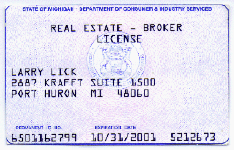
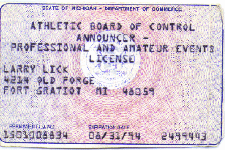
Check your state Web site or the local phone
book state pages for information about licensees. For real estate
licensees, you can find links to the regulating agencies in the various states
on our
Real Estate License Regulatory Agencies page of our Invest Web.
For various other regulatory agencies or other
information for a particular state, start with the state's official Web site.
Click here
for links to State sites.
Military Personnel
If your debtor is military, try these links:
Keep in mind that you should have extra
leverage when dealing with a military debtor compared to a civilian.
Credit problems can directly hurt the career of military personnel.
Accordingly, you have a good chance of structuring a work-out with a military
debtor who would prefer that his first sergeant or commanding officer not get
involved.
Interstate Commerce Commission
If you debtor is a truck driver, this agency will
have his record. Check the ICC's Web site or look in your phone book for
the branch nearest you.
Boat or Aircraft Registration
If you know or suspect that your debtor owns a
boat, check with the agency that licenses boats in the state of interest (which
may or may not be the same as the one that licenses autos). If the debtor
owns an airplane, check the the
FAA Web site. Even if the debtor doesn't own a plane, if you think the
debtor is a pilot, you can check the site for Airman Certificate information.
Sometimes a boat or airplane owner may change his
address property with one governmental agency, but not another. So, since
both aircraft and boats are usually taxed, by either or both state and local
authorities, you might also obtain useful information from those taxing
authorities.
Other Sources
The last one above is noteworthy because it is
an extensive public record site. Click on "public records." Also
click on hotlinks for some good links to reverse address/phone directories.
Also click on "on the record" for some more good links.
Help Is Available
As mentioned earlier, it is sometimes useful or
even necessary to have professional help in tracking down a hiding debtor.
There are numerous other companies that
specialize in locating your debtor and their assets. Many will do a "no
hit - no fee" transaction. That means that if they can't find anything for you
there is no fee or a very small charge. They do deserve something for
their time in trying. You can hire them for as much or as little
information as you want or your budget allows.
We are providing a list of hyperlinks to various
companies in case you would rather have someone else
do the information gathering or you don't have time for it. Web have no
experience with any of the companies and there are many more than those listed. If your budget
allows it you may consider having someone do the dirty work. They may be
able to find more information and find it faster than can. Some can
provide services for many other countries. The companies are listed
alphabetically and, as we have not personally used any of the listed companies,
we do not recommend one over the other. Neither do we do warrant their
work in any way.
Remember that you will still save hundreds or
thousands (depending on the amount of your judgment) of dollars than having a
judgment collector do it for you and they would be doing the same thing.
If your judgment is for $2,000.00 and it costs
you $100.00 to collect the judgment yourself, isn't that better than giving a
judgment collector $1,000.00 (they usually charge 50%)? You save $900.00!
It's actually $1,000.00 since you get your $100.00 back from the debtor.
And even better if you own a business and have to do this on a regular basis.
It is safe to say that you will save many thousands of dollars over time.
And, no one will be more motivated then you the creditor because no one cares
more about you getting your money than you do.
Tracer and Information Specialists
|


